
There are films that entertain. And then there are films that crawl under your skin and refuse to leave. Saltburn is one of those. Directed by Emerald Fennell - the same mind behind Promising Young Woman - this 2023 psychological thriller doesn’t just tell a story. It lures you into a gilded cage of privilege, desire, and decay, then locks the door behind you. You don’t watch it. You endure it.
It opens with a quiet, almost gentle scene: a university student, Oliver Quick, standing alone at a train station, clutching a suitcase. He’s from a modest background, quiet, observant, and painfully aware of how out of place he is. Then he gets invited to spend the summer at Saltburn, the sprawling English estate of the wealthy Catton family. It’s not an invitation. It’s a trap disguised as kindness. And once he steps onto that gravel drive, nothing will ever be the same. euro girls escort london might sound like a world away from this, but both are about the illusion of access - how someone outside the gates thinks they can slip in, only to realize they were never meant to be there at all.
The House That Wants to Eat You
Saltburn isn’t just a location. It’s a character. A gothic, overgrown mansion with marble floors that echo like tombstones, ceilings so high they swallow sound, and gardens that look like they haven’t been tended since the 1920s. The Cattons - Felix, his sister Venetia, and their eccentric father Sir James - live in a world of inherited wealth and emotional detachment. They don’t ignore Oliver. They absorb him. Like a ghost haunting a house that forgot it was empty.
Felix, played with chilling charm by Jacob Elordi, is the golden boy who looks like he stepped out of a Renaissance painting. He’s funny, cruel, effortlessly magnetic. He takes Oliver under his wing - or so it seems. But his affection feels like a game. A test. A slow-motion experiment to see how far a boy from nowhere will go to belong. The tension isn’t in loud arguments. It’s in the silence between bites at dinner. In the way Venetia stares at Oliver like he’s a specimen under glass. In the way Sir James, played by Richard E. Grant with unsettling warmth, offers advice that sounds like blessings but feels like curses.
Obsession as a Language
Oliver doesn’t fall in love with Felix. He falls into him. Like a man drowning and grabbing at the only thing floating nearby. Fennell doesn’t show this as romance. She shows it as possession. As a hunger that can’t be named. Oliver starts mimicking Felix’s habits - the way he drinks whiskey, the books he reads, the songs he hums. He begins to live inside Felix’s skin. And the more he does, the more the house starts to reflect him back. Mirrors crack. Paintings tilt. The garden grows wilder.
There’s a scene - early in the second act - where Oliver sneaks into Felix’s room and lies on his bed, breathing in the scent of his cologne. It’s not sexual. Not at first. It’s spiritual. Like a ritual. He’s trying to become him. To erase himself. This isn’t gay desire as it’s usually portrayed in film. It’s something older, darker. A longing to dissolve into another soul. To be unmade. The film doesn’t flinch from that. It leans in.
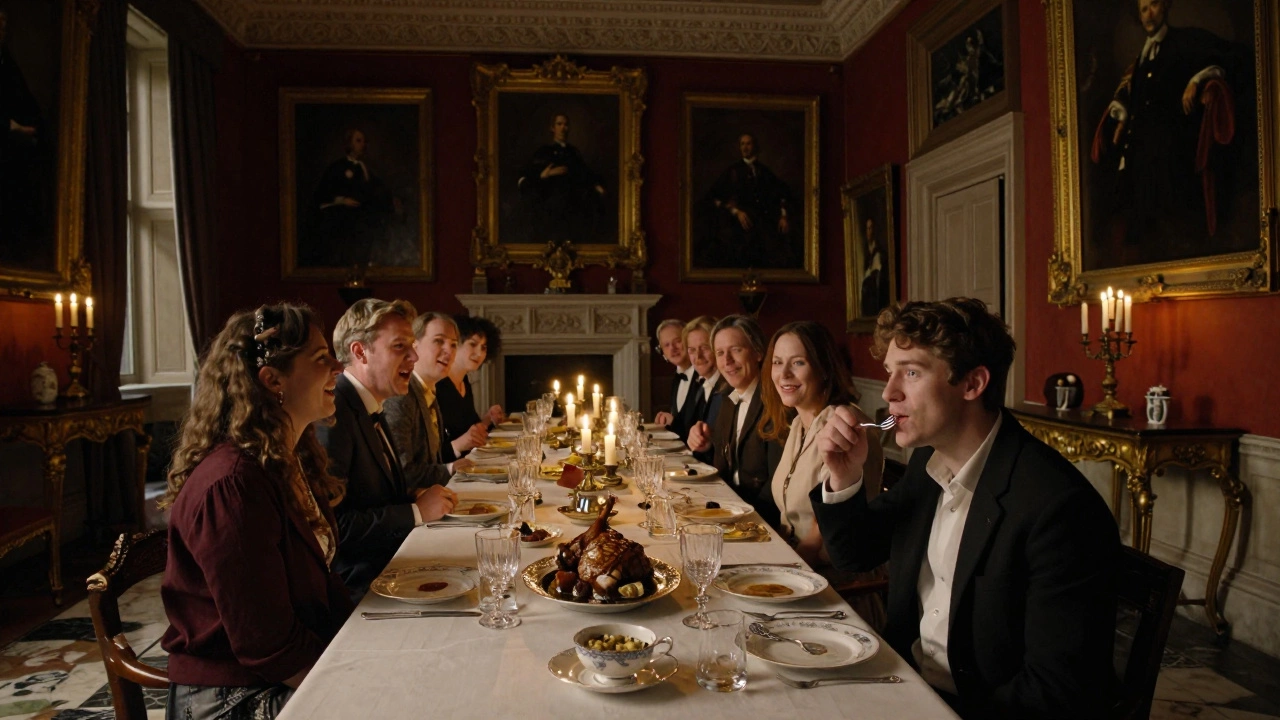
The Feast That Changes Everything
Midway through, the film delivers a sequence that will haunt you. A lavish dinner party. A roast lamb. Champagne. Laughter. And then - the unspoken rule breaks. Felix, drunk and bored, dares Oliver to eat from his plate. Oliver does. Then he takes a bite of Felix’s dessert. Then he licks the fork. The room freezes. No one says a word. But the silence screams louder than any scream could.
That moment isn’t about food. It’s about boundaries. About ownership. About what happens when someone who’s been treated like a guest decides they’re the rightful heir. The scene is shot in one long take. No music. No cuts. Just the clink of silverware, the rustle of fabric, and the slow realization that the rules of this world have just been rewritten - by someone who wasn’t even supposed to be at the table.
When the Mask Comes Off
By the third act, Saltburn stops being a psychological drama and becomes a gothic horror. The estate begins to rot. The family’s façade cracks. Oliver’s quietness turns into something colder. He doesn’t speak much, but his actions carry the weight of a thousand unspoken vows. He doesn’t want to be loved. He wants to be remembered. Even if it’s as the monster who broke the house.
There’s a moment near the end - after a devastating act of violence - where Oliver sits alone in the library, surrounded by books that once belonged to Felix. He picks up a pen. Writes something. Then burns it. We never see what he wrote. But we know it was his name. And he didn’t want to keep it. He wanted to vanish into the story. Into the house. Into the soil of Saltburn.
The final shot - a slow zoom into the heart of the estate, overgrown now, vines swallowing the windows - doesn’t feel like an ending. It feels like a burial. The house didn’t just hold a tragedy. It consumed it. And now, it’s hungry again.

Why Saltburn Feels So Real
What makes Saltburn so unsettling isn’t the violence. It’s the truth beneath it. Most of us have been Oliver at some point. The outsider who thought if they smiled enough, if they were quiet enough, if they mimicked the right gestures, they’d finally belong. We’ve all sat at a table where the laughter didn’t include us, but we laughed anyway. We’ve all tried to shrink ourselves to fit into someone else’s world.
And we’ve all wondered - what if I didn’t shrink? What if I took the whole damn table?
Fennell doesn’t judge Oliver. She doesn’t glorify him. She lets him be human. Flawed. Desperate. Brilliant. And terrifying. The film refuses to give us a villain. Or a hero. Just a boy who wanted to be seen - and ended up becoming something no one could control.
The Price of Belonging
There’s a line in the film that doesn’t get talked about enough: “I didn’t want to be invited. I wanted to be chosen.” That’s the core of Saltburn. It’s not about class. It’s not even about sex. It’s about the unbearable weight of being an outsider who believes belonging is a thing you can earn. And when you realize it’s not - what do you do?
Oliver doesn’t burn the house down. He lets it burn itself. Because the real tragedy isn’t the destruction. It’s the realization that the house was never his to begin with. And yet, he made it his. By force. By silence. By obsession.
Saltburn is not a film you watch to feel good. You watch it to feel something real. Something raw. Something that lingers in your bones long after the credits roll. It’s beautiful. It’s brutal. And it’s unforgettable.
And if you’ve ever felt like you didn’t belong - even for a second - you’ll see yourself in Oliver. And you’ll understand why he did what he did.
euro girl escort london - a phrase that sounds like a fantasy of access, of control, of stepping into a world that doesn’t belong to you. Just like Saltburn. Just like Oliver.
euro escort girls london - a mirror held up to the illusion of belonging. A reminder that some doors open only to let you in - so they can shut behind you forever.